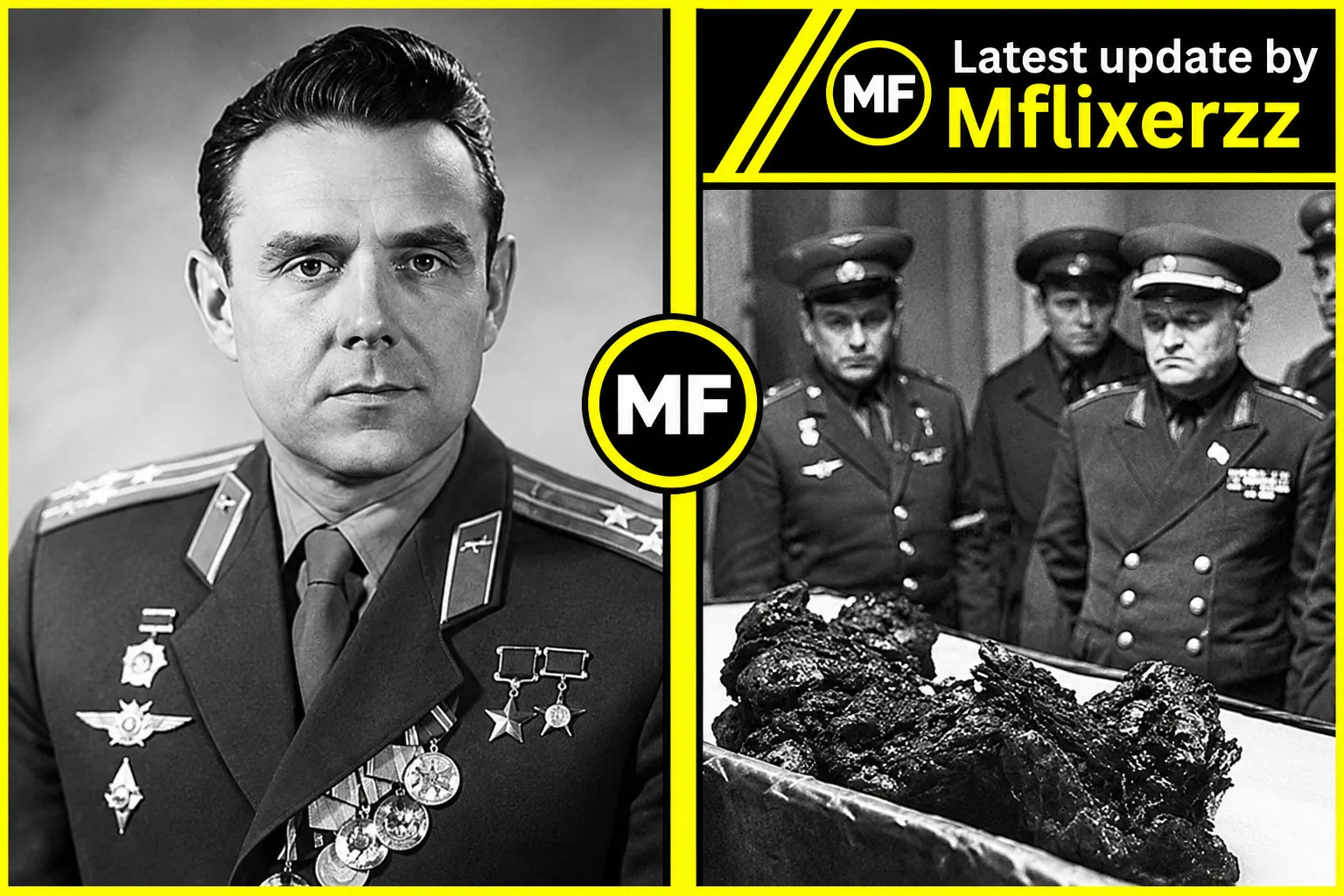
Vladimir Komarov: Biography, Age, Wife, Children, Space Mission, Death and Legacy
Vladimir Komarov was a Soviet cosmonaut, aerospace engineer and military pilot who became one of the most important figures in the early history of human spaceflight. Born on March 16, 1927, in Moscow, Soviet Union, he is remembered for his participation in the Voskhod 1 mission and his tragic final flight aboard Soyuz 1 in April 1967.
Komarov became the first human to travel into space twice. His achievements made him an important figure in the Soviet space programme, but his final mission ended in disaster when his spacecraft’s parachute system failed during its return to Earth. He died on April 24, 1967, becoming the first person to die during a spaceflight mission.
His life remains an important part of space exploration history, particularly because of his courage, professional experience and contribution to the development of early Soviet spacecraft.
Quick Bio of Vladimir Komarov
| Detail | Information |
| Full Name | Vladimir Mikhailovich Komarov |
| Date of Birth | March 16, 1927 |
| Date of Death | April 24, 1967 |
| Age | 40 Years |
| Birthplace | Moscow, Soviet Union |
| Nationality | Soviet |
| Profession | Cosmonaut, Aerospace Engineer, Military Pilot |
| Father | Mikhail Komarov |
| Mother | No widely verified public record |
| Wife | Valentina Yakovlevna Kiselyova |
| Children | Two |
| Education | Soviet military aviation and engineering institutions |
| Military Rank | Colonel |
| Space Agency | Soviet Space Programme |
| First Space Mission | Voskhod 1 (1964) |
| Second Space Mission | Soyuz 1 (1967) |
| Total Space Missions | 2 |
| Time in Space | Approximately 2 days, 3 hours and 4 minutes |
| Awards | Hero of the Soviet Union (twice) |
| Famous For | First human fatality during a spaceflight mission |
| Burial Place | Kremlin Wall Necropolis, Moscow |
Early Life and Childhood
Vladimir Mikhailovich Komarov was born on March 16, 1927, in Moscow, Soviet Union. He grew up in a working-class family during a period of major political and social changes in the country. From an early age, he developed a strong interest in aviation, aircraft and engineering.
During his childhood, Komarov enjoyed reading aviation magazines and learning about different types of aircraft. He also built model airplanes and showed an interest in understanding how flying machines worked. His fascination with aviation gradually developed into a serious ambition to become a professional pilot.
His early education took place in Moscow, where he demonstrated an interest in mathematics and technical subjects. These abilities later helped him pursue military aviation training and engineering studies.
The Second World War significantly affected his childhood. In 1941, following Germany’s invasion of the Soviet Union, his normal education was interrupted. He left school and worked on a collective farm for a period before pursuing his aviation ambitions.
In 1942, at the age of 15, Komarov entered a specialised Soviet Air Force school in Moscow. The institution provided training for young people interested in military aviation.
His father died during the war, leaving the family to face difficult circumstances. Despite these challenges, Komarov continued his education and worked toward becoming a military pilot.
His determination, interest in mathematics and passion for aircraft helped establish the foundation for his future career in aviation and space exploration.
Family Background and Parents
Vladimir Komarov came from a modest family in Moscow. His early family life was shaped by the difficult economic and political conditions of the Soviet Union during the 1930s and 1940s.
His father worked in different low-paying jobs to support the household. He died during the Second World War, when Vladimir was still young.
Information about his mother is less widely documented in accessible historical accounts. She supported the family during his early years, and her death in 1948 occurred shortly before Komarov completed his military aviation education.
Komarov also grew up with a half-sister, Matilda, who was born in 1915.
Although his family did not have extensive financial resources, his early interest in education and aviation helped him pursue opportunities that eventually led to a career in the Soviet military and space programme.
Education and Military Aviation Training
Komarov’s education was closely connected to his ambition to become a pilot.
After entering the specialised Air Force school in 1942, he studied aviation-related subjects and received training that prepared him for further military education.
He graduated with honours in 1945. Following the end of the Second World War, he continued his training at Soviet military aviation institutions.
In 1946, he began studying at the Chkalov Higher Air Force School in Borisoglebsk. He later completed his education at the A.K. Serov Military Aviation College in Bataisk.
In 1949, he graduated as a trained military pilot and received his commission as a lieutenant in the Soviet Air Force.
Komarov’s education did not stop after he became a pilot. He remained interested in engineering and technical developments, which later influenced his decision to pursue advanced studies.
In 1954, he enrolled at the Zhukovsky Air Force Engineering Academy. The institution provided advanced technical education and prepared military personnel for engineering responsibilities.
He graduated in 1959 and subsequently worked as a test pilot at the Central Scientific Research Institute.
His combination of military flying experience and engineering knowledge made him a valuable candidate for the Soviet space programme.
Military Career and Early Professional Experience
After graduating from military aviation college in 1949, Komarov began serving in the Soviet Air Force.
He initially worked as a fighter pilot with a military aviation regiment based in the North Caucasus region.
His responsibilities included operating military aircraft, maintaining flight proficiency and participating in training exercises.
In 1952, he was promoted to senior lieutenant. He later received an important position as chief pilot of a fighter aviation regiment.
His work required strong technical knowledge, discipline and the ability to operate aircraft under challenging conditions.
During this period, Komarov continued developing his engineering interests. He understood that aviation was advancing rapidly and that future aircraft would require increasingly sophisticated technical systems.
His decision to study engineering at the Zhukovsky Air Force Engineering Academy helped him develop the skills needed for experimental aviation and spacecraft development.
By the end of the 1950s, he had established himself as an experienced pilot and engineer.
Selection for the Soviet Space Programme
In 1960, Vladimir Komarov was selected as one of the original Soviet cosmonauts.
The Soviet Union was competing with the United States in the Space Race, and both countries were working to develop human spaceflight capabilities.
The Soviet space programme required pilots who could handle complicated equipment, understand spacecraft systems and operate under extreme conditions.
Komarov’s background made him particularly suitable for this work. He had military flying experience, engineering qualifications and knowledge of experimental aircraft.
He joined the first group of Soviet cosmonaut candidates, which included Yuri Gagarin and several other future space explorers.
The training programme involved physical conditioning, technical instruction, aircraft experience, parachute training and simulations of spaceflight conditions.
Cosmonauts also had to prepare for the effects of weightlessness, isolation and the physical challenges associated with returning to Earth.
Komarov became an important member of the group because of his technical knowledge and professional experience.
He was not simply being trained to fly a spacecraft. He also contributed to evaluating equipment, understanding spacecraft systems and preparing future missions.
NASA’s historical account of the first Soviet cosmonaut group identifies Komarov as the commander of Voskhod 1 and the first member of that group to return to space for a second mission.
Marriage and Wife: Valentina Yakovlevna Kiselyova
Vladimir Komarov married Valentina Yakovlevna Kiselyova in October 1950.
Their marriage began during the early years of his military aviation career, before he became internationally recognised as a cosmonaut.
Valentina supported her husband’s professional ambitions as he progressed from military pilot to engineer and eventually space explorer.
Komarov’s career required extensive training, military responsibilities and periods away from home. His involvement in the Soviet space programme also brought additional pressure and uncertainty to family life.
Valentina remained an important part of his personal life throughout his career.
The couple experienced the excitement surrounding his first spaceflight in 1964 and the difficulties associated with his second mission in 1967.
Following his death, Valentina and their children became part of the family left behind by one of the Soviet Union’s most famous space pioneers.
Children and Family Life
Vladimir Komarov and his wife Valentina had two children.
His family included a daughter named Irina and a son named Yevgeny, according to commonly cited biographical accounts.
Komarov tried to maintain a family life while managing the demanding responsibilities of military aviation and cosmonaut training.
His professional activities required long periods of preparation, travel and technical work.
Although his public identity became closely connected to space exploration, his family remained an important part of his private life.
His wife and children experienced the enormous public attention surrounding his missions, particularly after the tragic Soyuz 1 accident.
Komarov’s death in 1967 left his family without a husband and father, while the Soviet Union mourned the loss of one of its leading cosmonauts.
First Space Mission: Voskhod 1
October 12–13, 1964
Vladimir Komarov made his first journey into space as commander of Voskhod 1 in October 1964.
The mission was an important milestone in human spaceflight because it became the first successful mission to carry three people into orbit aboard a single spacecraft.
Komarov commanded the mission alongside Konstantin Feoktistov and Boris Yegorov.
Feoktistov was an engineer, while Yegorov was a physician. Their participation demonstrated that spaceflight could involve specialists beyond military test pilots.
The mission was designed to test the spacecraft, study the effects of spaceflight on the human body and demonstrate the Soviet Union’s growing capabilities in space exploration.
Voskhod 1 launched on October 12, 1964, and completed its mission successfully.
The crew spent approximately 24 hours in orbit before returning safely to Earth on October 13.
The mission attracted international attention because carrying three people into space was a significant technological achievement.
Komarov’s performance as commander strengthened his reputation within the Soviet space programme.
His successful first flight also helped establish him as one of the country’s most experienced cosmonauts.
Achievements and Recognition After Voskhod 1
Following the success of Voskhod 1, Komarov received national recognition for his contribution to Soviet space exploration.
He was awarded the title Hero of the Soviet Union, one of the country’s highest honours.
He also received the Order of Lenin for his achievements.
His experience as a cosmonaut and engineer made him an important figure in the development of future Soviet missions.
Komarov continued working with other cosmonauts and technical specialists, contributing to training, spacecraft evaluation and preparations for upcoming missions.
He was recognised not only for his flying ability but also for his engineering knowledge and understanding of complex spacecraft systems.
His first mission established him as a leading member of the Soviet cosmonaut corps.
Soyuz 1 Mission and Preparation
April 1967
Soyuz 1 was designed to test a new generation of Soviet spacecraft and demonstrate advanced spaceflight operations.
The mission was part of the Soviet Union’s efforts to develop the technology required for future lunar exploration.
Komarov was selected as the spacecraft’s commander and became the first cosmonaut to undertake a second spaceflight.
The original mission plan involved launching Soyuz 1 first, followed by another spacecraft, Soyuz 2. The two spacecraft were expected to meet in orbit, dock and allow cosmonauts to transfer between them.
However, the mission faced serious technical difficulties even before launch.
Earlier unmanned Soyuz test flights had experienced problems, raising concerns about the spacecraft’s reliability.
Despite these challenges, Soyuz 1 proceeded with its launch in April 1967.
Komarov was responsible for operating the spacecraft and managing the mission’s complicated technical systems.
His experience made him a suitable candidate for the demanding test flight, but the spacecraft would encounter problems that ultimately prevented the mission from succeeding.
Launch of Soyuz 1
On April 23, 1967, Soyuz 1 launched from the Baikonur Cosmodrome in the Soviet Union.
Komarov became the first cosmonaut to fly aboard the new Soyuz spacecraft during a crewed mission.
The spacecraft successfully reached orbit, but technical problems appeared shortly after launch.
One of its solar panels failed to deploy properly, reducing the spacecraft’s available electrical power.
The failure affected the operation of several onboard systems.
Komarov also experienced difficulties with the spacecraft’s orientation and navigation systems, making it harder to control the vehicle.
The planned mission involving Soyuz 2 was eventually cancelled because of the problems with Soyuz 1.
Komarov was instructed to return to Earth earlier than originally planned.
The spacecraft had completed a mission that was supposed to demonstrate important new technology, but its technical failures created a dangerous situation.
NASA’s historical safety review identifies the failed solar panel, reduced power reserves and difficulties with spacecraft systems as major problems during the mission.
Soyuz 1 Technical Problems
The Soyuz 1 mission encountered multiple failures that made Komarov’s journey increasingly difficult.
The first major problem involved the solar panel that failed to deploy correctly. This reduced the spacecraft’s electrical power and affected its systems.
The spacecraft also experienced problems with its orientation sensors and automatic control functions.
These difficulties made it challenging to maintain the correct position in orbit.
Komarov attempted to manage the spacecraft manually, but the technical problems continued.
The planned docking mission with Soyuz 2 was abandoned, and the decision was made to bring Komarov back to Earth.
He eventually managed to initiate the return sequence and guide the spacecraft through re-entry.
However, the most serious problem occurred during the final stage of the landing process.
The parachute system failed to operate correctly, resulting in the fatal crash.
Death During the Soyuz 1 Landing
April 24, 1967
Vladimir Komarov died on April 24, 1967, during the landing of Soyuz 1.
After completing the orbital portion of the mission, he successfully guided the spacecraft back through Earth’s atmosphere.
However, the spacecraft’s landing system experienced a catastrophic failure.
The main parachute failed to deploy correctly, and the backup parachute became tangled with the spacecraft’s drag chute.
Without an effective parachute system to slow its descent, the capsule fell toward the ground at an extremely high speed.
Soyuz 1 crashed in the Orenburg region of the Soviet Union, killing Komarov instantly.
He was 40 years old.
His death became the first fatality involving a human during a spaceflight mission.
The tragedy exposed serious technical and safety problems within the early Soviet space programme.
Komarov’s death also became a major turning point in the development of spacecraft safety and landing systems.
NASA’s safety documentation describes the parachute entanglement and the spacecraft’s fatal impact.
Funeral and Burial
Following his death, Vladimir Komarov received a state funeral in Moscow.
His death attracted widespread attention throughout the Soviet Union and internationally.
Government officials, military personnel, scientists and members of the public mourned the loss of the experienced cosmonaut.
His remains were cremated, and his ashes were placed in the Kremlin Wall Necropolis in Moscow.
The burial location was traditionally reserved for important Soviet political, military and national figures.
His funeral became a symbol of the sacrifices associated with early human space exploration.
Komarov was remembered as a pioneer who lost his life while testing a spacecraft designed to advance the Soviet space programme.
Awards and Honours
Vladimir Komarov received several important awards during his career and posthumously.
His achievements were recognised by the Soviet government because of his contribution to aviation, engineering and space exploration.
His major honours included:
- Hero of the Soviet Union, awarded twice.
- Order of Lenin.
- Military recognition for his service in the Soviet Air Force.
- Recognition for commanding the first successful three-person space mission.
- Posthumous honours for his contribution to Soviet space exploration.
His name was also given to several geographical and scientific features, including the lunar crater Komarov and asteroid 1836 Komarov.
These honours helped preserve his contribution to the history of space exploration.
Legacy and Historical Impact
Vladimir Komarov remains an important figure in the history of human spaceflight.
His first mission aboard Voskhod 1 demonstrated the Soviet Union’s ability to send three people into orbit aboard a single spacecraft.
His second mission, Soyuz 1, became one of the most tragic events in early space exploration.
His death exposed the risks associated with developing new spacecraft and highlighted the importance of reliable engineering, testing and safety procedures.
Komarov’s experience as a pilot and engineer also made him an important contributor to the early Soviet cosmonaut programme.
His career demonstrated the combination of technical knowledge, military experience and professional discipline required for human spaceflight.
Today, his name remains associated with the early years of the Space Race and the sacrifices made by the first generation of cosmonauts.
His story continues to be remembered in historical accounts, educational materials and discussions about spacecraft safety.
Vladimir Komarov’s Influence on Space Exploration
Komarov’s career took place during the Space Race between the Soviet Union and the United States.
During the 1960s, both countries were competing to develop advanced spacecraft, send humans into orbit and eventually reach the Moon.
The Soviet Union achieved several important milestones during this period, including Yuri Gagarin’s first human spaceflight and the first mission carrying multiple people into space.
Komarov contributed to this period through his work as a military pilot, engineer and cosmonaut.
His experience with Voskhod 1 helped demonstrate the possibilities of multi-person space missions.
The Soyuz 1 disaster, although tragic, also became an important lesson in spacecraft engineering and mission safety.
The Soyuz programme continued after his death and eventually became one of the most important spacecraft programmes in space exploration history.
Komarov’s contribution is therefore remembered not only for his successful first mission but also for the historical significance of his final flight.
Net Worth and Financial Background
Vladimir Komarov’s exact net worth was never publicly established.
He was a Soviet military officer, engineer and cosmonaut who received government recognition and official honours for his professional achievements.
Unlike modern astronauts and celebrities, Soviet cosmonauts did not generally have publicly documented personal fortunes.
There is no reliable historical financial record that establishes his personal wealth.
His historical importance is associated with his military service, engineering experience and contribution to human spaceflight rather than financial success.
Frequently Asked Questions (FAQs)
Who was Vladimir Komarov?
Vladimir Komarov was a Soviet cosmonaut, military pilot and aerospace engineer who became famous for commanding Voskhod 1 and Soyuz 1.
When was Vladimir Komarov born?
He was born on March 16, 1927, in Moscow, Soviet Union.
How old was Vladimir Komarov when he died?
He was 40 years old when he died on April 24, 1967.
Who was Vladimir Komarov’s wife?
His wife was Valentina Yakovlevna Kiselyova, whom he married in October 1950.
How many children did Vladimir Komarov have?
He had two children with his wife Valentina.
What was Vladimir Komarov famous for?
He was famous for being the first human to die during a spaceflight mission and for commanding the first successful three-person spaceflight aboard Voskhod 1.
What was Vladimir Komarov’s first space mission?
His first mission was Voskhod 1, which launched on October 12, 1964.
What was Vladimir Komarov’s second space mission?
His second and final mission was Soyuz 1, launched on April 23, 1967.
Why did Vladimir Komarov die?
He died when the parachute system of his Soyuz 1 spacecraft failed during its return to Earth, causing the capsule to crash.
When did Vladimir Komarov die?
He died on April 24, 1967, during the Soyuz 1 landing.
Where did Vladimir Komarov die?
He died in the Orenburg region of the Soviet Union, where his spacecraft crashed.
Was Vladimir Komarov the first person to die during a spaceflight?
Yes. He became the first person to die during a spaceflight mission, although he was not the first person to die in a space-related accident.
How long did Vladimir Komarov spend in space?
Across his two missions, he spent approximately two days, three hours and four minutes in space.
What happened to Soyuz 1?
Soyuz 1 experienced several technical failures, including problems with its solar panel and control systems. During landing, its parachute system failed, causing a fatal crash.
Where is Vladimir Komarov buried?
His ashes are buried in the Kremlin Wall Necropolis in Moscow, Russia.
What awards did Vladimir Komarov receive?
He received the Hero of the Soviet Union award twice and the Order of Lenin.
What is named after Vladimir Komarov?
The lunar crater Komarov and asteroid 1836 Komarov are named in his honour.
Final Thoughts
Vladimir Komarov was a pioneering Soviet cosmonaut whose life and career became an important part of human spaceflight history. Born in Moscow in 1927, he developed an early interest in aviation and worked hard to become a military pilot and aerospace engineer.
His successful Voskhod 1 mission in 1964 made him the commander of the first spacecraft to carry three people into orbit. This achievement established his position among the leading figures of the Soviet space programme.
His second mission aboard Soyuz 1 in April 1967 ended in tragedy when the spacecraft’s parachute system failed during its return to Earth. His death at the age of 40 became the first fatality during a human spaceflight mission.
Although his career was relatively short, his contribution to early space exploration remains historically important. His achievements, professional dedication and tragic final mission continue to be remembered as part of the history of the Space Race.
Continue Exploring Our Latest Article: Haile Selassie I Biography: Ethiopia’s Emperor, Political Life and Legacy