Research Dossier for a Target Company: Complete Guide, Checklist, Examples and Due Diligence Process (2026)
Making an important business decision without understanding the company involved can create unnecessary risks. Whether an organization is considering an acquisition, exploring a partnership, evaluating a supplier or preparing an investment, reliable company information is essential.
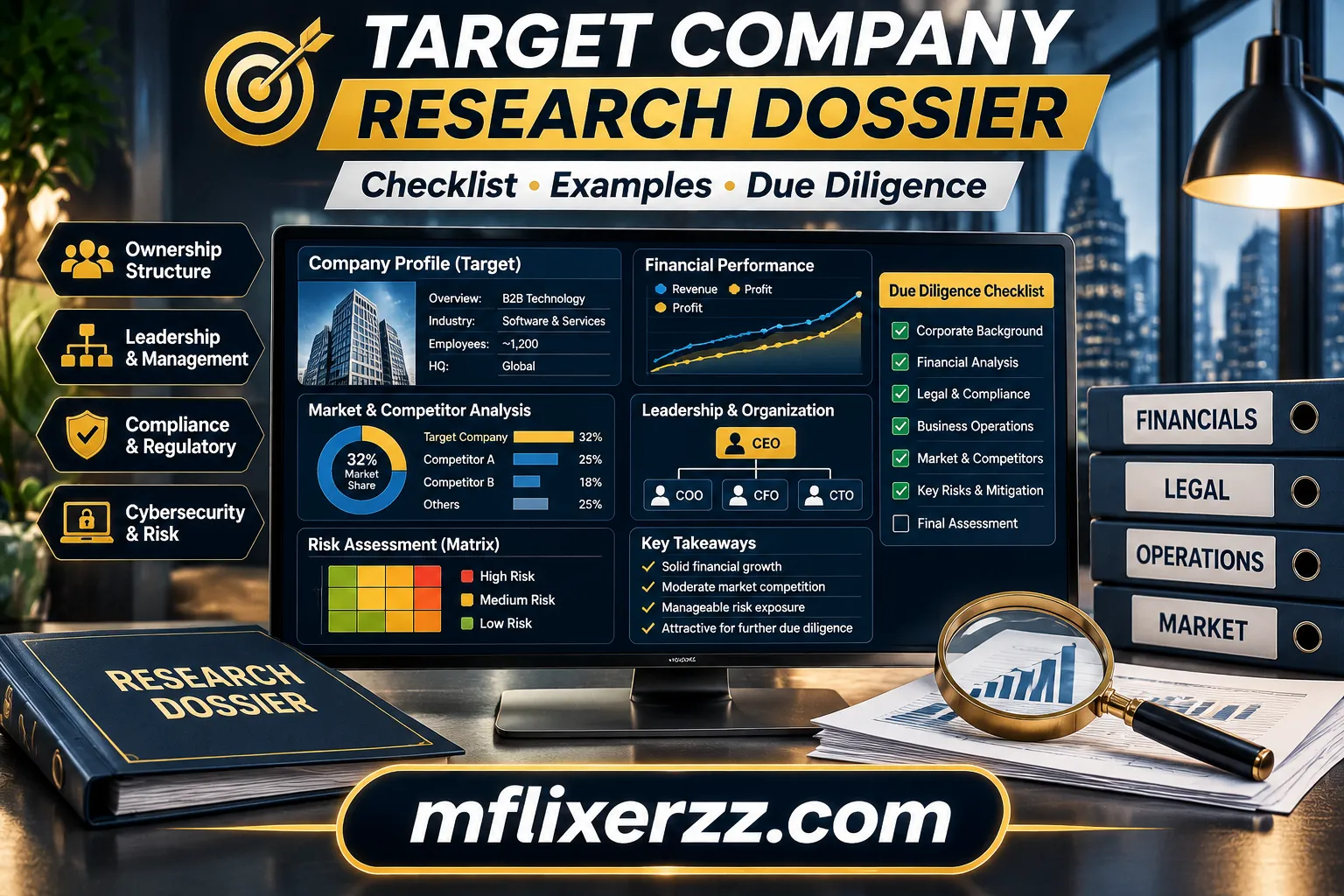
This is where a research dossier for a target company becomes valuable. It is a structured document that brings together important information about a business, including its background, ownership, leadership, products, financial performance, competitors, reputation and potential risks. Instead of relying on scattered internet searches or promotional statements, a research dossier organizes relevant information into one comprehensive report. It helps decision-makers understand what a company does, how it operates, where its strengths lie and what issues may require further investigation.
In 2026, company research has become more important as businesses face changing market conditions, regulatory requirements, financial uncertainty and increasing expectations around transparency. Public company registers, financial databases, regulatory filings and digital research tools make it easier to collect information, but the accuracy of that information still needs to be checked.
A well-prepared dossier does more than describe a business. It turns verified information into practical insights that support better commercial decisions.
Quick Review
| Detail | Information |
| Topic | Research Dossier for a Target Company |
| Category | Business Research and Intelligence |
| Main purpose | Evaluate a company’s background and position |
| Primary users | Investors, analysts and business owners |
| Other users | Sales teams, consultants and researchers |
| Main information | Company profile and business activities |
| Financial research | Revenue, profit, cash flow and debt |
| Ownership research | Shareholders and beneficial owners |
| Management research | Directors and senior executives |
| Market analysis | Industry, customers and competitors |
| Risk assessment | Legal, financial and operational risks |
| Research methods | Public records, reports and databases |
| Supporting technology | AI, data analysis and research platforms |
| Typical output | Structured business research report |
| Research year | 2026 |
What Is a Research Dossier for a Target Company?
A research dossier for a target company is a detailed report containing verified information about a specific business.
The term target company refers to the organization being investigated or evaluated. It might be a business that an investor wants to acquire, a potential commercial partner, a competitor, a supplier or an organization being considered for a major contract.
The dossier collects relevant information from different sources and organizes it into a consistent structure.
For example, an investment team researching a technology company might investigate its founding history, ownership structure, annual revenue, products, intellectual property, competitors and outstanding legal matters.
A sales department might prepare a similar document but concentrate more heavily on the company’s decision-makers, business priorities, current projects and potential requirements.
The research objective determines which information deserves the most attention.
A research dossier is not simply a company profile. It is an evidence-based assessment designed to answer specific business questions.
Why Is a Target Company Research Dossier Important?
Businesses rarely make important decisions based on one piece of information. They need to understand how different factors influence one another.
A company may have an impressive website and strong market recognition but still experience financial difficulties. Another organization may report rapid growth while depending heavily on one customer or supplier.
A research dossier helps uncover these details.
Better investment decisions: Investors can examine financial performance, ownership, management and business risks before committing capital.
Acquisition preparation: Buyers can identify potential problems involving debt, contracts, intellectual property and company structure.
Stronger partnerships: Organizations can evaluate whether a potential partner has the experience, resources and reputation needed for a successful relationship.
Supplier evaluation: Procurement teams can assess financial stability, operational capacity and supply-chain dependencies.
Competitive intelligence: Businesses can understand competitors’ products, market positions, expansion plans and strategic priorities.
Sales preparation: Sales professionals can learn about a prospect’s leadership, business model and likely commercial requirements before approaching decision-makers.
What Should a Research Dossier Include?
A comprehensive company dossier should cover several important areas. The exact structure depends on the purpose of the investigation, but the following sections provide a useful starting point.
1. Executive Summary
The executive summary provides a short overview of the target company and the most important findings from the research.
It should identify the company, explain its main activities and highlight significant strengths, weaknesses and outstanding questions.
Although this section appears first, it is often easier to write after completing the remaining research.
A useful executive summary should answer three questions: What does the company do? What are its most important characteristics? What should the decision-maker know before proceeding?
Keep this section concise and focus on findings that directly influence the intended business decision.
2. Company Background
This section establishes the identity and history of the organization.
It should include the company’s legal name, trading name, registration number, headquarters, incorporation date, business activities and relevant subsidiaries.
Researchers should distinguish between a company’s registered legal identity and the brand name it uses publicly.
For businesses operating in multiple countries, it is also important to identify the relevant legal entities and their relationships.
Official company registries are generally more dependable for legal identity than promotional website descriptions.
3. Ownership Structure
Understanding who owns and controls a target company is an important part of corporate research.
The ownership section should identify shareholders, parent companies, subsidiaries, beneficial owners and other individuals or entities with significant control.
A company may have a relatively simple ownership structure, or it may belong to a larger corporate group with several layers of subsidiaries.
Researchers should also examine voting rights and control arrangements rather than relying exclusively on shareholding percentages.
The Financial Action Task Force’s guidance on beneficial ownership emphasizes the importance of accurate and accessible information about the real individuals who ultimately own or control legal entities.
This information can help identify undisclosed relationships, ownership concentration and potential compliance concerns.
4. Products and Services
A research dossier should clearly explain what the target company sells or provides.
This section identifies its main products, services, customer groups, pricing models and important revenue sources.
Researchers should also examine whether the company depends on one major product or has several independent business lines.
For technology businesses, it may be useful to investigate software platforms, patents, licensing arrangements and proprietary technologies.
Understanding the product portfolio helps decision-makers assess whether the company has a sustainable commercial offering.
5. Business Model
The business model explains how an organization creates value and generates revenue.
For example, a software company might generate income through monthly subscriptions, enterprise licences and technical support.
A manufacturing business may depend on product sales, distribution agreements and long-term supply contracts.
Researchers should identify:
- Main revenue streams.
- Customer acquisition methods.
- Pricing arrangements.
- Distribution channels.
- Operating expenses.
- Major suppliers.
- Customer concentration.
- Dependence on recurring revenue.
The objective is to understand how the company operates financially and commercially.
6. Leadership and Management
The management section examines the people responsible for directing the business.
It should identify the chief executive, finance director, board members, founders and other important executives.
Their professional backgrounds, previous positions and relevant industry experience can provide useful context.
Recent management changes should also be recorded, particularly when senior executives have departed or new leadership has been appointed.
Frequent leadership changes do not automatically indicate a problem, but they may justify additional questions about organizational stability and strategic direction.
7. Financial Performance
Financial research is one of the most important parts of a target company dossier.
It helps determine whether a business has sufficient financial resources, generates sustainable earnings and manages its obligations effectively.
Where available, researchers should examine three to five years of financial information.
| Financial metric | What it explains |
| Revenue | Total income from business activities |
| Gross profit | Revenue remaining after direct costs |
| Operating profit | Profit from core business operations |
| Net income | Profit after expenses and taxes |
| Cash flow | Movement of cash into and out of the business |
| Total assets | Resources owned or controlled |
| Total liabilities | Financial obligations |
| Total debt | Borrowed financial obligations |
| Current ratio | Ability to cover short-term liabilities |
| Equity | Residual value attributable to owners |
Financial figures should not be examined independently.
For example, increasing revenue may appear positive, but falling operating margins could indicate rising costs.
Likewise, a profitable company may experience cash-flow difficulties if customers take too long to pay invoices.
The purpose of financial analysis is to understand the quality and sustainability of business performance, not simply collect impressive numbers.
8. Market Position and Competitor Analysis
A target company’s performance should be considered within the wider industry.
This section identifies its main competitors, customer segments, market trends and competitive advantages.
Researchers should compare businesses offering similar products or targeting similar customers.
| Research area | Questions to investigate |
| Market size | How large is the relevant industry? |
| Competitors | Which businesses offer similar products? |
| Pricing | How does the company compare with competitors? |
| Customer base | Who purchases its products? |
| Market position | Is it a leader or a smaller participant? |
| Differentiation | What makes its offering distinctive? |
| Industry trends | What developments could influence demand? |
A useful competitor comparison should focus on measurable differences rather than general statements about which company is better.
It may include pricing, product range, geographic presence, customer groups, financial performance and distribution capabilities.
9. Legal and Regulatory Background
Legal research helps identify issues that could affect the target company’s operations or future value.
Depending on the industry and jurisdiction, this may involve reviewing litigation, regulatory investigations, licences, contractual obligations, insolvency information and intellectual-property disputes.
Sanctions screening may also be relevant, particularly for international partnerships and transactions.
The EU Sanctions Helpdesk explains that ownership and control can involve more than direct majority shareholding. Voting arrangements, management rights and other forms of influence may also matter.
Researchers should distinguish confirmed legal findings from allegations, unresolved disputes and unverified media reports.
A negative news article should not automatically be treated as proof of wrongdoing.
10. Reputation and Public Perception
A company’s reputation can influence customer confidence, employee relationships and commercial partnerships.
This section examines how the organization is perceived by customers, employees, industry professionals and the wider public.
Potential sources include customer reviews, media coverage, public statements, professional networks and industry publications.
Researchers should look for repeated patterns rather than relying on one isolated complaint.
For example, recurring reports of poor customer support may indicate an operational issue worth investigating.
At the same time, reviews and online comments should be treated carefully because they may be incomplete, biased or manipulated.
11. Recent News and Developments
A company dossier should include a timeline of important developments.
These may involve funding rounds, acquisitions, product launches, partnerships, executive appointments, layoffs, regulatory announcements and geographic expansion.
A useful approach is to review developments from the previous 12 to 24 months.
Each entry should include its date, source and relevance to the target company’s position.
This section helps decision-makers understand what has changed recently and which developments could influence future performance.
12. Risks and Opportunities
The final analytical sections bring the research together.
Potential risks include financial instability, customer concentration, regulatory exposure, management turnover, supply-chain dependence and reputational problems.
Opportunities may include entering new markets, launching additional products, developing strategic partnerships or acquiring complementary businesses.
The researcher should explain why each finding matters.
A list of risks without context is not particularly useful. The dossier should describe the possible impact and identify what further evidence is required.
How to Prepare a Target Company Research Dossier
Preparing a reliable dossier requires a structured process. The following steps can help organize the work.
Step 1: Define the research objective.
Determine why the company is being investigated. An acquisition assessment will require different information from a supplier review or sales prospecting report.
Step 2: Confirm the correct legal entity.
Identify the registered business name, company number, jurisdiction and official website. This helps prevent confusion between companies with similar names.
Step 3: Collect primary information.
Start with official company filings, annual reports, regulatory records, corporate announcements and public registers.
Step 4: Research management and ownership.
Identify directors, senior executives, shareholders and beneficial owners where information is available.
Step 5: Examine financial information.
Compare revenue, margins, cash flow, debt and profitability over multiple reporting periods.
Step 6: Analyze the market.
Identify competitors, customers, industry trends and the company’s position within its sector.
Step 7: Investigate risks.
Review legal records, sanctions information, regulatory announcements, reputation and operational dependencies where relevant.
Step 8: Verify important claims.
Compare information from multiple independent sources and record any contradictions.
Step 9: Write the findings and recommendations.
Summarize what the evidence means for the original business decision.
Best Sources for Company Research in 2026
The quality of a research dossier depends heavily on its sources.
Official records should generally receive priority because they provide information submitted to or published by relevant authorities.
The following resources can help researchers gather company information.
| Research source | Information available |
| Companies House | UK company records and filings |
| SEC EDGAR | US corporate regulatory filings |
| FATF | Beneficial ownership guidance |
| OFAC | US sanctions screening |
| EU Sanctions Helpdesk | EU sanctions and ownership guidance |
| Annual reports | Financial and operational performance |
| Company websites | Products, leadership and announcements |
| Industry publications | Market developments and competitor activity |
| Court records | Legal proceedings and judgments |
| Professional networks | Leadership and employment information |
For UK businesses, Companies House provides free access to company details, registered addresses, business activities, filing histories, officers, insolvency information and charges.
Its company information service was updated on June 9, 2026.
For US-listed businesses, the SEC’s EDGAR database provides public access to millions of regulatory filings, including annual reports, quarterly reports and ownership disclosures.
The OFAC Sanctions List Search tool uses fuzzy name matching to help identify potential matches against US sanctions lists.
These resources are useful starting points, although the relevant national registers and regulatory authorities will depend on the target company’s jurisdiction.
Using AI for Target Company Research
Artificial intelligence is becoming increasingly useful for business research.
AI-assisted tools can help researchers organize large volumes of information, summarize annual reports, compare competitors and identify potential gaps in a company profile.
For example, an analyst can use AI to extract revenue figures from several annual reports and organize them into a comparison table.
Another application involves reviewing a company’s public announcements and creating a chronological timeline of important developments.
AI can also help prepare questions for management interviews and identify areas requiring additional investigation.
However, AI-generated findings should never be accepted without verification.
AI can accelerate research, but it cannot replace reliable evidence or professional judgment.
Researchers should verify important facts against original filings, official records and other trustworthy sources. They should also avoid entering confidential transaction information or sensitive personal data into tools that are not approved for such use.
Common Mistakes to Avoid
Even a detailed company dossier can be misleading if the research process is weak.
Some common mistakes include:
- Relying entirely on the company’s promotional website.
- Confusing a brand name with its registered legal entity.
- Using outdated financial information.
- Ignoring subsidiaries and ownership relationships.
- Treating allegations as confirmed legal findings.
- Comparing companies from different industries without context.
- Using unverified traffic or employee estimates.
- Ignoring customer and supplier concentration.
- Failing to record source dates.
- Treating AI-generated information as verified evidence.
A particularly important mistake is confusing a research dossier with full legal or financial due diligence.
A public-information dossier is useful for preliminary screening, but an acquisition or major investment may require professional legal, tax, financial, technical and regulatory reviews.
Practical Target Company Research Checklist
Before finalizing a dossier, researchers can use the following checklist.
- Confirm the company’s legal identity.
- Verify its registration and official address.
- Review its company history.
- Identify its ownership structure.
- Research beneficial owners where available.
- Identify directors and senior management.
- Review products and services.
- Understand its business model.
- Analyze available financial statements.
- Identify major competitors.
- Examine customers and suppliers.
- Review important industry developments.
- Check relevant legal and regulatory records.
- Assess sanctions exposure where relevant.
- Review reputation and media coverage.
- Identify major financial and operational risks.
- Record opportunities and strategic advantages.
- Verify important information against primary sources.
- Document unresolved questions and evidence gaps.
- Prepare a final recommendation.
What Should the Final Research Dossier Look Like?
A professional dossier should be easy to read, logically organized and supported by evidence.
The executive summary should appear at the beginning, followed by company information, financial analysis, market research, management details and risk assessments.
Tables can make financial comparisons and competitor analysis easier to understand.
A timeline can help communicate recent developments, while an ownership chart can explain complex corporate structures.
Each important finding should include its source and research date.
It is also useful to assign confidence levels to individual findings.
| Confidence level | Meaning |
| High | Confirmed by reliable primary evidence |
| Medium | Supported by credible secondary sources |
| Low | Based on incomplete or unverified information |
| Unknown | Information could not be established |
The dossier should finish with a short assessment explaining whether the company appears suitable for the intended opportunity, what concerns remain and what additional checks are necessary.
Final Thoughts
A research dossier for a target company is an important tool for understanding businesses before making significant commercial decisions.
It brings together company identity, ownership, management, products, financial performance, competitors, legal information and strategic developments in one organized document.
The latest 2026 research environment provides access to several useful resources, including Companies House, SEC EDGAR, FATF guidance and sanctions-screening tools. These sources make it easier to verify important information, although researchers must still consider differences between jurisdictions and disclosure requirements.
A strong dossier should not simply repeat information found online. It should explain what the evidence means, identify potential concerns and highlight opportunities that deserve further attention.
Ultimately, the value of a company research dossier comes from the quality of its evidence and the decisions it helps people make. By following a structured research process, businesses, investors and analysts can approach potential opportunities with greater confidence and a clearer understanding of the risks involved.
Frequently Asked Questions
1. What is a research dossier for a target company?
A research dossier is a structured report containing verified information about a business. It typically covers company history, ownership, leadership, products, financial performance, competitors, reputation and potential risks.
2. Why is a target company research dossier important?
It helps investors, business owners and analysts understand an organization before making important decisions. It can reveal financial concerns, ownership relationships, competitive advantages and potential commercial opportunities.
3. What information should a company research dossier include?
A comprehensive dossier should include an executive summary, company background, ownership, management, products, business model, financial analysis, market position, competitors, legal information and risk assessment.
4. Which websites are useful for researching a target company?
Useful resources include Companies House for UK companies, SEC EDGAR for US corporate filings, FATF for beneficial ownership guidance, OFAC for sanctions screening and official company websites for corporate announcements.
5. Is a research dossier the same as due diligence?
No. A research dossier organizes information and supports preliminary business assessments. Full due diligence is generally more extensive and may involve professional legal, financial, tax, technical and regulatory investigations.
6. How long does it take to prepare a company research dossier?
A basic public-information dossier may take several hours, while a detailed investigation can require days or weeks. The time depends on company size, ownership complexity, available records and the purpose of the research.
7. Can AI create a research dossier?
AI can help collect, summarize and organize publicly available information. However, important findings must be verified against reliable sources. AI should support the research process rather than replace independent checks and professional judgment.
Explore Our Latest Posts: mflixerzz