Ukulele History: Origins, Tuning, Chords, Beginner Tips & More you Should Know
Ukulele history begins in Hawaiian, but the instrument’s roots reach back to Portuguese string instruments brought to the islands in the late 19th century. Today, the ukulele is a small, portable four-string instrument known for its bright sound and beginner-friendly feel. Its history, however, is only part of the story. Choosing the right uke, learning ukulele tuning, understanding a ukulele chord chart, reading tabs, and practicing simple songs can quickly turn a first-time player into a confident beginner.
What Is a Ukulele?
A ukulele is a small four-stringed instrument that belongs to the lute family. It looks somewhat like a miniature guitar, but its construction, tuning, string arrangement, and sound are different.
The four strings are normally tuned G-C-E-A, from the G string through the A string. Standard ukulele tuning uses a high G in the common re-entrant setup, which gives the instrument its distinctive sound.
The instrument is also commonly called a uke. That shorter name is widely used by players, teachers, musicians, and music websites.
One reason the ukulele is so popular with beginners is its size. It is easy to carry, and its nylon strings are generally gentler on the fingers than steel guitar strings.
Ukulele History: Where Did It Come From?
The modern ukulele developed in Hawaii, but it was strongly influenced by Portuguese instruments.
Portuguese immigrants from Madeira arrived in Hawaii in 1879 and brought small string instruments with them. Among the important predecessors were the braguinha, machete, rajão, and cavaquinho. Hawaiian makers then modified these instruments, helping create what became the modern ukulele.
This is why saying that the ukulele was simply “invented in Hawaii” misses an important part of its history. Its identity became Hawaiian, but its musical ancestry includes Portuguese instruments.
The Metropolitan Museum of Art dates one early Hawaiian ukulele to around 1880 and notes that Portuguese settlers brought the braguinha to Hawaiʻi in 1879.
How Did the Ukulele Reach Hawaii?
The arrival of Portuguese workers in Hawaiʻi was a major turning point.
The Smithsonian reports that several of the early ukulele makers came from Madeira and arrived aboard the SS Ravenscrag in 1879 to work on sugar plantations. Among the important early makers were Manuel Nunes, Augusto Dias, and José do Espírito Santo.
These men were skilled instrument makers. Their work helped transform the imported Portuguese-style instruments into something suited to Hawaiian musical tastes.
Manuel Nunes opened a workshop in Honolulu in 1880, while Dias and Espírito Santo later established their own workshops. By the late 1880s, all three were producing instruments for the local market.
That period was important because the instrument was no longer simply an imported Portuguese object. It was becoming a distinctly Hawaiian instrument.
What Was the Ukulele Originally Called?
There is no single simple answer because the modern ukulele evolved from several Portuguese instruments.
The braguinha was one important predecessor. The machete, rajão, and cavaquinho also contributed to the instrument’s development. The Smithsonian specifically identifies these Portuguese instruments as influences on the Hawaiian ukulele.
The braguinha was a small guitar-like instrument from Madeira. When Portuguese immigrants brought instruments such as this to Hawaiʻi, local makers adapted their design and construction.
So, if you’re asking what was the ukulele originally called, it is more accurate to discuss its Portuguese predecessors rather than claim that the ukulele itself had one original Portuguese name.
How Did the Ukulele Get Its Name?
The origin of the word ukulele has several explanations.
One common explanation connects the Hawaiian word with ideas translated as “jumping flea,” possibly describing the fast movement of a player’s fingers. The Smithsonian notes that there are multiple explanations for the name rather than one universally accepted story.
Queen Liliʻuokalani also offered a different interpretation connected with the idea of a gift or something coming from a distant place.
The important point is that the name became firmly connected with Hawaiʻi as the instrument developed there.
The Ukulele and Hawaiian Culture
The ukulele quickly became part of Hawaiian musical culture.
The instrument gained support within the Hawaiian royal court, particularly under King David Kalākaua, who encouraged Hawaiian music and cultural traditions. The Metropolitan Museum notes that the ukulele found favor at the royal court and was adapted to accompany hula performances.
This royal connection helped give the instrument cultural importance.
The ukulele was therefore more than a convenient little string instrument. It became part of how Hawaiian music and culture were presented both within the islands and to audiences outside Hawaiʻi.
How the Ukulele Became Popular Worldwide
The instrument eventually moved beyond Hawaiʻi and became popular across the United States.
One of the biggest moments came at the 1915 Panama-Pacific International Exposition in San Francisco. Hawaiian musicians performed at the Hawaiian Pavilion, exposing huge numbers of visitors to the instrument and Hawaiian music. The Smithsonian describes this event as the point when the ukulele gained international prominence.
The resulting popularity created a major commercial market.
Mainland manufacturers began producing their own versions, and the instrument became associated with popular entertainment. A louder variation, the banjo ukulele, appeared around 1916.
The ukulele later went through periods of lower and higher popularity, but it never disappeared. Its small size and approachable learning curve helped it experience several revivals.
Topic Foryou: Incfidelibus: Meaning, Origin, and Why People Are Searching for It
Types of Ukulele
Modern players normally encounter four main ukulele sizes:
| Type | General character | Common use |
| Soprano | Small, traditional sound | Beginners and classic uke style |
| Concert | Slightly larger | Beginners and general playing |
| Tenor | Larger body and neck | Players wanting more room |
| Baritone | Largest common size | Deeper sound and guitar-like feel |
Soprano, concert, and tenor ukuleles generally use the familiar G-C-E-A tuning. Baritone ukuleles are different and are commonly tuned D-G-B-E, like the highest four strings of a guitar.
For many new players, a soprano or concert model is a sensible starting point.
Best Ukulele for Beginners
The best ukulele for beginners is not necessarily the cheapest instrument available.
A good first uke should stay reasonably well in tune, feel comfortable in your hands, have an easy-to-play neck, and produce a clean sound.
A very cheap instrument can sometimes create unnecessary frustration. If the tuning machines slip or the strings sit too high above the fretboard, beginners may struggle even when they are practicing correctly.
A soprano is a traditional choice and is compact. A concert gives slightly more room while remaining easy to carry. For adults with larger hands, a concert may feel more comfortable.
Fender also highlights portability and the softer feel of ukulele strings as reasons the instrument can work well for beginners.
Best Ukulele for Beginners on a Budget
If you’re searching for the best ukulele for beginners budget friendly, focus on build quality rather than appearance.
You do not need an expensive professional instrument to learn basic chords and songs.
Look for:
- Stable tuning machines
- Comfortable action
- Straight neck
- Decent-quality strings
- Solid fret finishing
- A case or gig bag if possible
A moderately priced beginner uke from a reputable maker can often be a better long-term choice than an extremely cheap model.
You should also decide whether you want soprano or concert size before comparing prices. The cheapest option is not automatically the best fit for your hands or playing style.
How to Choose Your First Ukulele
Start with comfort.
Hold the instrument and see whether your fretting hand can comfortably reach the first few frets. Your strumming arm should also feel relaxed.
Next, check the neck and strings. The strings should not feel excessively high from the fretboard. Tuning machines should turn smoothly and hold the pitch reasonably well.
Then consider the size.
A soprano is compact and traditional. A concert gives more room. A tenor provides an even larger playing area and can be useful for more experienced players.
If you expect to travel frequently, also consider the case. A good protective bag or hard case can be worth the extra cost.
Ukulele Tuning Explained
Understanding ukulele tuning is one of the first skills every beginner should learn.
Standard tuning is:
G – C – E – A
The C string represents the middle C on a piano. In common high-G tuning, the G string is tuned an octave higher than a player might expect from a low-to-high string arrangement.
This re-entrant arrangement is part of what gives the ukulele its characteristic sound.
It also means you should not assume that a standard guitar tuner setting will automatically give you the correct ukulele notes.
How to Tune a Ukulele
To tune a ukulele, use a chromatic tuner or a tuner specifically designed for the instrument.
First, identify the four strings and their target notes:
G → C → E → A
Play one string at a time and watch the tuner. If the pitch is too low, gradually tighten the tuning peg. If it is too high, loosen it carefully.
Make small adjustments instead of turning the peg aggressively.
After tuning all four strings, check them again. Changing the tension of one string can sometimes affect the instrument slightly, especially with new strings.
Fender confirms G-C-E-A as standard ukulele tuning and also provides ukulele tuning through its Fender Tune app.
Ukulele Tuner Options
A ukulele tuner can be a clip-on device, smartphone app, online tuner, or another electronic tuner.
A chromatic tuner is especially useful because it detects the pitch rather than forcing you to select only a specific instrument.
This also answers the common tuner guitar ukulele question: a chromatic guitar tuner can generally be useful for a ukulele if it can detect the required G, C, E, and A notes. The important part is tuning to the correct pitches, not simply selecting “guitar.”
Fender’s tuning tools provide support for ukulele as well as guitar-related tuning needs.
Learning the Ukulele Tuning by Ear
A tuner is the easiest choice for beginners, but eventually you can learn to recognize whether your uke sounds noticeably sharp or flat.
Even experienced players commonly use electronic tuners because they save time and improve accuracy.
The best habit is simple: tune before you practice.
If your instrument is out of tune, you may learn chord shapes correctly but still hear unpleasant results. That can make it harder to develop a good musical ear.
| Section | Best format |
| How to Play Ukulele | Short paragraphs |
| Ukulele Tuning | G-C-E-A chart |
| How to Tune a Ukulele | Step-by-step |
| Ukulele Tuner | Comparison table |
| Guitar Tuner vs Ukulele Tuner | Comparison table |
| Ukulele Chords | Main chord chart/table |
| Ukulele Chord Chart | Visual-style text table |
| Chord Changes | Short explanation + practice table |
| Beginner Chord Progressions | Progression table |
| Ukulele Songs | Song/chord table |
| Ukulele Tablature | Example + explanation |
| Tabs vs Chord Charts | Comparison table |
| Practice Routine | Daily practice table |
For example, the main chord reference could look like this:
| Chord | G-C-E-A Shape | Difficulty | Why Learn It |
| C | 0-0-0-3 | Easy | Excellent first chord |
| Am | 2-0-0-0 | Easy | Common in beginner songs |
| F | 2-0-1-0 | Easy | Useful with C and Am |
| G | 0-2-3-2 | Medium | Important for many progressions |
| G7 | 0-2-1-2 | Medium | Adds variety |
| D | 2-2-2-0 | Medium | Common major chord |
The G-C-E-A order is important because, unlike a guitar, the lowest-pitched ukulele string in standard re-entrant tuning is the C string; the G string is typically tuned an octave higher.
We can also add a dedicated tuning chart:
| String | Standard Note | String Position |
| 4th | G | G |
| 3rd | C | C |
| 2nd | E | E |
| 1st | A | A |
Fender confirms G-C-E-A as standard tuning and provides dedicated ukulele tuning alongside its guitar tuning tools.
How to Improve at Ukulele
The fastest way to improve is not to practice for hours once a week. Short, regular sessions are usually easier to maintain.
Start each session by checking your tuning. Then spend a few minutes forming your main chords. After that, practice moving between two chords without stopping your strumming.
Once the changes become easier, add a simple song.
A useful beginner routine looks like this:
| Practice | Suggested time | Main goal |
| Tune the uke | 2 minutes | Correct pitch |
| Chord shapes | 5 minutes | Clean notes |
| Chord changes | 5 minutes | Smooth movement |
| Strumming | 5 minutes | Steady rhythm |
| Song practice | 10 minutes | Apply everything |
| Tabs or fingerpicking | 5 minutes | Build coordination |
You do not have to follow these exact times. The important thing is consistency.
Choosing the Right Ukulele Size
There are four main ukulele sizes: soprano, concert, tenor, and baritone. The soprano is the smallest common size, while the baritone is the largest.
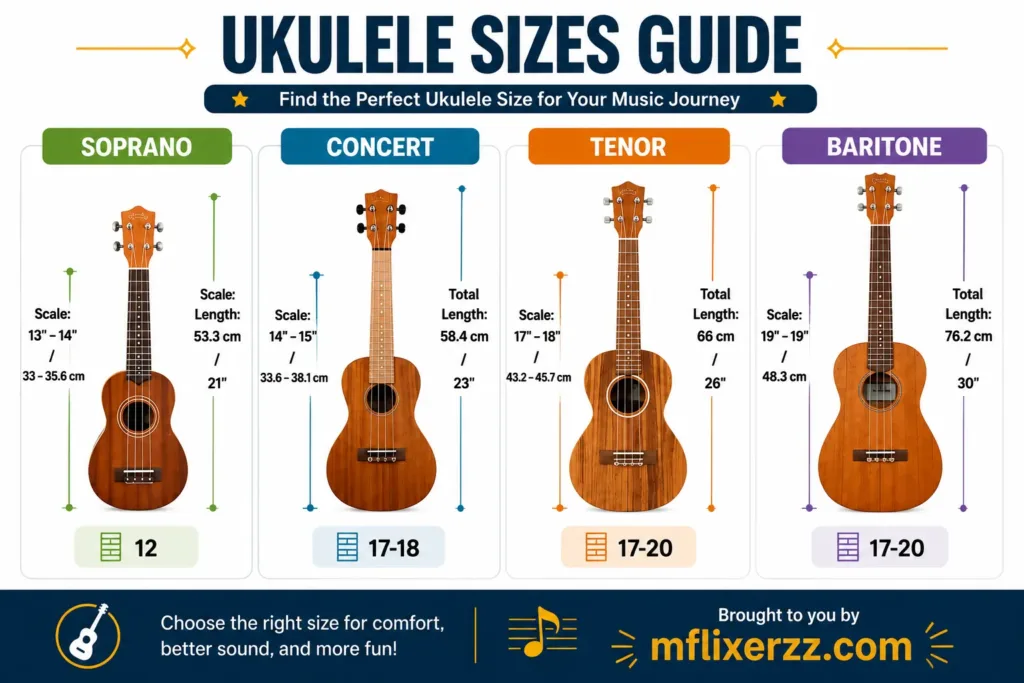
The choice is mostly about comfort, sound, and playing style.
| Ukulele size | Approx. size | Typical tuning | Best suited for |
| Soprano | 21 inches | G-C-E-A | Small hands, travel, classic sound |
| Concert | 23 inches | G-C-E-A | Most beginners |
| Tenor | 26 inches | G-C-E-A | Larger hands, fuller sound |
| Baritone | 30 inches | D-G-B-E | Guitar players, deeper tone |
Soprano, concert, and tenor models generally share the same standard tuning and chord shapes. The baritone is different because it normally uses D-G-B-E tuning. ([turn0search8]turn0search8)
Soprano Ukulele
The soprano is the traditional small ukulele many people imagine when they hear the word “uke.”
It is lightweight, portable, and has a bright, lively tone. Its smaller fretboard can be comfortable for players with smaller hands, but some adults with larger fingers may prefer more space.
It is also an excellent choice if portability is your main concern.
Concert Ukulele
A concert ukulele is slightly larger than a soprano and provides more room between the frets.
For many beginners, this makes chord formation easier. It still has the familiar ukulele character but usually offers a little more body and tonal warmth.
If you are unsure what to buy for your first instrument, the concert size is a practical all-round option. Current beginner guides from Kala also place soprano and concert among the most suitable starting sizes. ([turn0search8]turn0search8)
Tenor Ukulele
The tenor is larger again and gives your fretting hand more space.
It can be particularly comfortable for adults with larger hands. Its larger body can also provide a fuller and more resonant sound.
Players interested in fingerpicking or performing may prefer the tenor.
Baritone Ukulele
The baritone is the largest of the four common ukulele sizes.
It is different from the others because standard baritone tuning is D-G-B-E, matching the tuning of the four highest-pitched strings of a guitar.
That makes it especially interesting for guitar players moving to ukulele.
However, beginners should remember that standard soprano, concert, and tenor chord diagrams do not transfer directly to baritone because of the different tuning.
Ukulele vs Guitar
A ukulele and guitar are related, but they are not simply the same instrument in different sizes.
| Feature | Ukulele | Guitar |
| Common strings | 4 | 6 |
| Typical standard tuning | G-C-E-A | E-A-D-G-B-E |
| Size | Smaller | Larger |
| Common strings | Nylon | Steel or nylon |
| Portability | Very high | Lower |
| Beginner chords | Often simpler | More complex |
| Sound | Bright and compact | Wider tonal range |
The ukulele’s smaller body makes it easier to carry, while its four-string layout can make basic chord learning less intimidating.
That does not mean guitar is harder for every person. Your hands, musical goals, and preferred sound matter.
Uke vs Ukulele: Are They the Same?
Yes.
Uke is simply a common shortened name for ukulele.
You will often see musicians use “uke” in casual conversation, lesson titles, song descriptions, and online communities.
So if someone says, “I just bought a new uke,” they are talking about a ukulele.
Best Ukulele Case for Travel Protection
A good case becomes especially important when you take your instrument outside the house.
If you are looking for the best ukulele case for travel protection, consider how much protection you actually need.
A lightweight gig bag is convenient for short trips, lessons, and everyday carrying. A padded gig bag provides more protection than a thin fabric cover.
For flights, long road trips, or situations where the instrument may be exposed to pressure or impacts, a hard case can provide substantially more physical protection.
Look for:
- Good internal padding
- A secure neck area
- Strong zippers or closures
- Comfortable carrying straps
- Adequate space for accessories
- Moisture-resistant construction
- Protection around the instrument’s body
The case should fit your specific ukulele size. A soprano case will not properly protect a larger tenor or baritone.
How to Protect a Ukulele While Traveling
Before traveling, loosen nothing unless the instrument manufacturer specifically recommends it.
Instead, make sure the ukulele is properly secured inside its case.
Avoid leaving it in a hot vehicle for long periods. Extreme temperature changes can affect wood, glue joints, finish, and tuning stability.
For air travel, check the airline’s current baggage rules before leaving. Policies can vary, and an instrument that fits as cabin baggage on one airline may be handled differently by another.
If the trip involves significant temperature or humidity changes, allow the ukulele time to adjust gradually after arrival rather than immediately exposing it to a very different environment.
Common Ukulele Tuning Problems
New players often think a ukulele that keeps going out of tune must be defective.
That is not always the case.
New strings can stretch during the first several days. Frequent tuning during this period is normal.
Other causes can include loose tuning machines, temperature changes, incorrect string installation, or accidentally turning the wrong tuning peg.
If the pitch changes dramatically after every strum, inspect the tuning machines and bridge area.
It is also worth checking whether you are tuning to the correct octave. Standard high-G tuning has the G string at a higher octave than a low-G setup. ([turn0search31]turn0search31)
High-G vs Low-G Ukulele Tuning
High-G and low-G are two different approaches to the fourth string.
With high-G, the G string is tuned an octave higher, creating the classic re-entrant ukulele arrangement.
With low-G, the G string is tuned an octave lower, creating a more linear pitch sequence.
Both can be useful.
High-G produces the familiar traditional ukulele feel. Low-G can provide a wider lower range and may appeal to players who enjoy fingerpicking or want a more guitar-like string sequence.
Concert and tenor ukuleles are commonly used with both high-G and low-G setups. ([turn0search31]turn0search31)
How to Maintain a Ukulele
Basic maintenance does not need to be complicated.
Wipe the strings and body with a soft, clean cloth after playing. This removes sweat and dirt that can gradually affect the finish and strings.
Keep the instrument stored safely when you are not playing it.
Do not leave it leaning against a wall where it can easily fall.
If you have a wooden ukulele, pay attention to its environment. Very dry or excessively humid conditions can affect wood instruments.
Regularly inspect the bridge, neck, tuning machines, frets, and strings. Small problems are easier to address before they become expensive repairs.
When Should You Replace Ukulele Strings?
There is no single replacement schedule that works for every player.
The useful question is how the strings sound and feel.
Replace them when they become dull, uncomfortable, visibly worn, difficult to keep in tune, or when their tone has noticeably changed.
Someone who plays every day may need replacements much sooner than someone who plays occasionally.
After installing new strings, expect some additional tuning while they settle.
How to Clean a Ukulele
Use a soft, dry cloth for routine cleaning.
Do not spray household cleaning products directly onto the instrument.
For deeper cleaning, use a product that is specifically suitable for your ukulele’s finish and follow the manufacturer’s instructions.
The strings can collect oils from your fingers, so wiping them after playing is a simple habit that can help keep the instrument feeling fresh.
How to Store a Ukulele
The safest place for your uke is inside an appropriate case or gig bag when you are not using it.
Avoid direct sunlight, heaters, air-conditioning vents, damp areas, and places with major temperature swings.
A stable indoor environment is generally better than constantly moving the instrument between very different conditions.
If your ukulele is made from solid wood, proper humidity control becomes more important because wood responds to moisture changes.
Ukulele Practice: What Beginners Should Avoid
One of the biggest mistakes is trying to learn too much at once.
You do not need twenty chords on your first day.
Start with four or five useful shapes. Practice them until they sound clean. Then work on changing between them.
Another mistake is ignoring rhythm.
A player with three chords and good timing can sound much better than someone who knows twenty chords but cannot keep a steady beat.
Do not rush through songs either. Playing slowly and accurately gives your hands a stronger foundation.
Ukulele History Timeline
The development of the ukulele happened over many decades rather than in a single moment.
| Period | Important development |
| 19th century | Portuguese string instruments develop and evolve |
| 1879 | Portuguese immigrants arrive in Hawaiʻi with related instruments |
| 1880s | Hawaiian makers develop the modern ukulele |
| Late 19th century | The instrument becomes associated with Hawaiian music and culture |
| Early 20th century | Ukulele popularity spreads beyond Hawaiʻi |
| 1915 | Hawaiian music and ukulele gain major exposure at the Panama-Pacific International Exposition |
| 1910s–1920s | Mainland ukulele craze grows |
| 20th century | New sizes and designs appear |
| Modern era | Ukulele becomes a global beginner and performance instrument |
The Smithsonian identifies the 1879 arrival of Portuguese immigrants and the work of early Hawaiian makers as major parts of the instrument’s development. It also documents the important role of the 1915 San Francisco exposition in expanding the ukulele’s popularity.
FAQ About the Ukulele
How to read ukulele tablature tabs?
Ukulele tabs use four horizontal lines to represent the four strings. Numbers tell you which fret to play. A 0 means the string is played open, while multiple numbers arranged together can indicate notes played at the same time.
The key is to identify the string represented by each line and then follow the numbers from left to right.
What was the ukulele originally called?
The modern ukulele developed from Portuguese instruments including the braguinha, machete, rajão, and cavaquinho. Therefore, it is more accurate to describe these as important predecessors rather than saying the ukulele had one single original name.
How to tune a ukulele?
Standard ukulele tuning is G-C-E-A. Use a chromatic or ukulele-specific tuner, play each string separately, and adjust the tuning peg until the tuner shows the correct note. Always check the strings again after the first complete pass.
How to play the ukulele?
Start by learning how to hold the instrument, then learn a few basic chords such as C, Am, F, and G. Practice changing between them while keeping a steady strumming rhythm. Once those skills improve, apply them to simple songs.
How do you spell ukulele?
The standard spelling is ukulele.
It is sometimes shortened to uke, but “ukulele” is the full and standard English spelling.
Is ukulele easier than guitar?
Many beginners find the ukulele easier because it has four strings, a smaller body, and relatively simple beginner chord shapes. However, difficulty depends on the individual player and the type of music they want to learn.
What are the four strings on a ukulele?
Standard ukulele tuning uses G, C, E, and A. In common high-G tuning, the G string is tuned one octave higher than the linear sequence might suggest.
What is the easiest ukulele size for beginners?
Soprano and concert are common beginner choices. A concert can provide more room for the fingers, while a soprano is smaller and highly portable. Kala’s current beginner guidance recommends soprano or concert for many new players.
Can a guitar tuner tune a ukulele?
A chromatic tuner can generally tune a ukulele as long as it can detect the required pitches. You must tune to G-C-E-A rather than the standard guitar tuning sequence.
How often should you tune a ukulele?
Check the tuning before each practice session. New strings may require more frequent adjustment while they stretch and settle.
What is a uke?
“Uke” is an informal shortened name for ukulele.
Which ukulele is best for travel?
A soprano is particularly convenient because it is the smallest of the four common sizes. A concert is still highly portable while offering more fret space.
What is the difference between soprano, concert, tenor, and baritone?
Soprano is the smallest common size, followed by concert, tenor, and baritone. Soprano, concert, and tenor normally use G-C-E-A, while baritone normally uses D-G-B-E. Larger sizes generally provide more physical space and can produce a fuller sound.
Last Wording Of My Searches
The ukulele is much more than a small four-string instrument. Its history connects Portuguese musical traditions with the culture of Hawaiian, while its simple design has helped it become a popular instrument worldwide. For beginners, the smartest path is to choose a comfortable size, learn G-C-E-A tuning, practice a few useful chords, and build a steady daily routine. A reliable tuner, protective travel case, and basic maintenance will keep the instrument ready to play. Whether you call it a ukulele or simply a uke, regular practice matters more than owning an expensive instrument or memorizing dozens of chords.